Implementing Avoiding Microplastics Tips into Daily Workflows and Visual Communication
Integrating health-conscious habits into a busy professional schedule requires more than good intentions; it demands a systematic approach to decision-making. Avoiding microplastics tips are often presented as isolated lifestyle hacks, but for entrepreneurs, educators, and productivity-minded individuals, they function best as operational protocols. When treated as a standard operating procedure rather than a sporadic effort, reducing plastic exposure becomes a seamless part of procurement, content creation, and daily routine management. This shift from reactive avoidance to proactive planning ensures consistency without sacrificing efficiency.
The challenge for many professionals is not a lack of information but a lack of visual structure. This is where specialized design assets, such as an avoiding microplastics tips vector infographic template, become essential tools. These resources bridge the gap between raw data and actionable knowledge. Whether you are a blogger creating educational content, a corporate trainer designing wellness modules, or a small business owner updating sustainability policies, having a pre-structured visual framework accelerates the communication process. It allows you to focus on the accuracy of the message rather than the mechanics of layout design.
Visualizing the Process: From Data to Actionable Steps
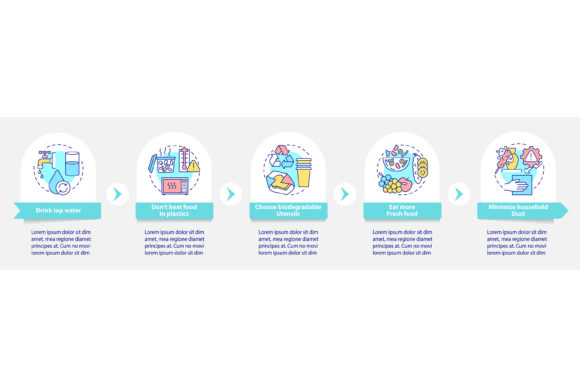
Effective implementation relies on clear visualization. A data visualization with 5 steps provides a cognitive scaffold that makes complex environmental health information digestible. For creators and marketers, this format is particularly valuable because it aligns with how audiences process instructional content. Instead of presenting a wall of text regarding filtration systems or packaging alternatives, a linear workflow breaks the information down into sequential milestones. This reduces cognitive load for both the creator and the end-user.
When utilizing a process timeline chart, the narrative shifts from abstract warnings to concrete progression. In a professional context, this might look like a quarterly transition plan for an office kitchen or a content calendar for a health coaching business. The timeline format implies movement and achievability. It suggests that avoiding microplastics is a journey with defined checkpoints rather than an overwhelming binary state of success or failure. By mapping out these stages visually, teams can track compliance, measure progress, and identify bottlenecks in their adoption of new habits.
Leveraging Design Assets for Consistency and Efficiency
For freelancers and publishers working under tight deadlines, asset compatibility is non-negotiable. Access to files in JPG, EPS, PNG, SVG, and AI formats ensures that your avoiding microplastics tips vector infographic template integrates smoothly across various platforms. Scalable Vector Graphics (SVG) and Adobe Illustrator (AI) files are critical for print materials and high-resolution displays, allowing for infinite resizing without quality loss. Meanwhile, PNG and JPG formats serve immediate digital needs, such as social media posts, email newsletters, or internal presentation slides.
This multi-format availability supports a unified brand identity. A marketer can use the same core visual element for a detailed white paper and a quick Instagram carousel, maintaining visual consistency while optimizing for different channels. The workflow layout with linear icons serves as a versatile foundation that can be customized to match specific brand colors and typography. This flexibility is vital for professionals who need to produce high-quality educational materials rapidly without commissioning custom illustrations for every new project.
Operationalizing Avoidance Strategies in Professional Environments
Avoiding microplastics tips must be contextualized to fit specific professional workflows. For an educator or trainer, the "drink tap water presentation design elements" are not merely decorative; they are pedagogical tools. They provide a visual anchor during lectures or workshops, helping students retain key concepts about hydration safety and filtration. The design elements act as cues that guide the audience through the logic of why tap water, when properly filtered, is often superior to bottled alternatives in terms of both microplastic content and environmental impact.
In a business operations context, these tips inform procurement policies. A linear icon set can be adapted into a checklist for office managers evaluating vendors. Before purchasing breakroom supplies, the team can reference the visual workflow to verify that products meet low-plastic standards. This transforms a subjective preference into an objective quality control metric. By embedding these criteria into existing purchasing workflows, organizations reduce the mental friction associated with sustainable choices. The decision has already been structured; the staff simply follows the established visual protocol.
Integration Points: Before, During, and After Projects
The utility of these resources extends across the entire lifecycle of a project or habit formation cycle. Understanding where to apply them maximizes their return on investment.
- Pre-Project Planning: Use the 5-step data visualization to scope out the feasibility of a plastic-free initiative. Before launching a wellness campaign, map out the necessary infrastructure changes using the timeline chart. This helps in budgeting time and resources accurately, preventing scope creep.
- Active Execution: During content creation or policy rollout, the vector templates serve as real-time guides. Writers can use the linear icons as subheadings to structure articles, ensuring comprehensive coverage. Office managers can post the workflow layout in communal areas as a gentle, visual reminder of proper water filtration usage or waste sorting procedures.
- Post-Implementation Review: After a designated period, use the original process timeline as a benchmark for evaluation. Did the team reach step three by the projected date? If not, was the timeline unrealistic, or were there external barriers? The visual record facilitates more productive retrospectives by providing a shared reference point for discussion.
Quality Control and Long-Term Usability
Sustainability initiatives often fail due to poor user experience. If avoiding microplastics feels cumbersome, adherence drops. High-quality design assets mitigate this risk by making the correct choice the easy choice. A well-designed drink tap water presentation clarifies the benefits of filtration systems instantly, removing ambiguity. When information is presented cleanly, users are more likely to trust the source and adopt the recommended behaviors. This is especially true for health-related topics where clarity equates to credibility.
Furthermore, the organization of these digital assets impacts long-term usability. Professionals should maintain a structured library of these templates, tagged by use case and file type. When a new need arises—such as a last-minute request for a sustainability update from a client or stakeholder—having a ready-to-use avoiding microplastics tips vector infographic template saves hours of production time. This preparedness allows for agile responses to trending topics or emerging research without compromising on visual quality or factual depth.
Adapting Templates for Diverse Audiences
One of the significant advantages of editable vector files is the ability to tailor the complexity of the information. A process timeline chart designed for industry experts might include technical specifications about micron ratings and polymer types. However, the same base template can be simplified for a general consumer blog or a primary school educational packet. The underlying structure remains consistent, preserving the logical flow, while the content density adjusts to the audience's expertise level.
This adaptability is crucial for freelancers and agencies serving multiple clients in different niches. A single robust template pack can support a healthcare provider, an eco-friendly e-commerce store, and a municipal water authority simultaneously. By mastering the customization of these linear icons and workflow layouts, creatives can deliver bespoke value efficiently. The key is to view the template not as a finished product, but as a modular system for communicating complex processes clearly.
Strategic Alignment with Broader Goals
Ultimately, avoiding microplastics tips are most effective when aligned with broader personal or organizational objectives. For a productivity enthusiast, reducing toxin exposure is a performance optimization strategy. For a business, it is a risk management and brand differentiation tactic. The visual tools discussed here facilitate this alignment by making the intangible tangible. They convert vague health concerns into managed projects with clear deliverables and measurable outcomes.
By treating the avoidance of microplastics as a structured workflow supported by professional-grade design assets, we move beyond guilt-driven consumption changes toward empowered, systematic improvement. Whether you are designing a presentation, overhauling an office supply chain, or simply trying to organize your own household routines, the integration of clear, scalable, and logical visual frameworks ensures that your efforts are sustainable in every sense of the word. The combination of practical knowledge and accessible design creates a pathway where health-conscious decisions become the default setting in a demanding professional life.