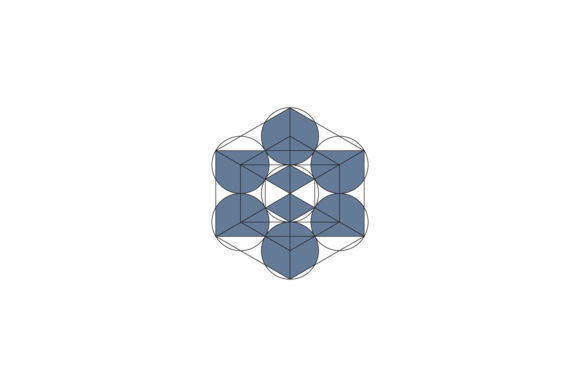
Hexagon from Circle: Practical Geometry for Design and Strategy
The transition from a circle to a hexagon represents one of the most efficient relationships in geometry, yet it remains underutilized in professional design and strategic planning. Hexagon from Circle is not merely a drafting exercise; it is a fundamental framework for creating modular systems, optimizing spatial layouts, and establishing visual harmony. For professionals ranging from UX designers and architects to content strategists and educators, understanding this geometric derivation offers tangible benefits in workflow efficiency and structural integrity. The concept moves beyond abstract mathematics into applied utility, providing a reliable method for generating consistent, scalable, and aesthetically balanced assets.
The Functional Value of Circular Derivation
At its core, Hexagon from Circle relies on the principle that the radius of a circle equals the side length of an inscribed regular hexagon. This mathematical certainty eliminates guesswork in both digital and physical creation. When professionals evaluate tools or methodologies, they prioritize reliability and precision. This geometric relationship delivers exactly that by anchoring complex structures to a single, unchanging metric. Unlike freeform drawing or arbitrary grid systems, deriving a hexagon from a circle ensures that every angle is precisely 120 degrees and every side is identical.
This precision matters significantly in production environments. For graphic designers creating logos or icon sets, this method guarantees symmetry that raster-based tracing cannot match. For makers and fabricators using CNC machines or laser cutters, it reduces material waste through optimal nesting. The value proposition here is consistency. When you build a system based on Hexagon from Circle, you are establishing a foundational logic that scales without degradation. Whether you are designing a single badge or tiling a massive mural, the underlying geometry remains mathematically sound, reducing the need for corrective adjustments later in the project lifecycle.
Strengths in Modular Systems and Tiling
The most immediate practical application of this concept lies in tessellation. Hexagons are unique among regular polygons because they tile a plane perfectly without gaps or overlaps while maintaining the closest packing density. This makes Hexagon from Circle indispensable for professionals working with patterns, textures, and organizational charts.
- Spatial Efficiency: Hexagonal grids cover more area with less perimeter than square grids, making them ideal for data visualization and map interfaces where edge effects need minimizing.
- Visual Flow: The six-point symmetry allows for multidirectional movement, which is superior to the rigid vertical-horizontal bias of square grids in user interface design.
- Structural Integrity: In physical manufacturing and packaging, the circular derivation ensures load distribution is even across all vertices, enhancing durability.
- Scalability: Because the construction is ratio-based, assets created via Hexagon from Circle can be resized infinitely without losing proportional accuracy.
For entrepreneurs and product developers, these strengths translate directly to resource optimization. A packaging designer using this geometry can create boxes that stack securely and use cardboard more efficiently. A web developer can implement CSS clip-paths based on exact circular ratios, ensuring responsive elements maintain their shape across breakpoints. The strength of this approach is its universality; the same geometric truth applies whether you are coding in SVG or cutting plywood.
Evaluating Usability and Workflow Integration
While the theory is elegant, the real test for any professional tool or concept is how it integrates into existing workflows. Hexagon from Circle performs exceptionally well in vector-based environments like Adobe Illustrator, Figma, and CAD software. Most modern design tools include native polygon generators tied to circular bounding boxes, making execution instantaneous. However, the true usability comes from understanding the manual construction, which serves as a fallback when automated tools fail or when custom proportions are required.
In educational settings, this concept bridges the gap between theoretical math and hands-on learning. Educators find that teaching geometry through Hexagon from Circle provides students with a tactile understanding of radius, diameter, and trigonometry. It transforms abstract numbers into visible, constructible forms. For serious hobbyists and DIY enthusiasts, the method requires only a compass and straightedge, lowering the barrier to entry for high-precision craftsmanship. You do not need expensive software to achieve professional-grade geometric accuracy; you simply need to respect the relationship between the curve and the straight line.
Quality Control and Common Pitfalls
Despite its simplicity, executing Hexagon from Circle correctly requires attention to detail. Professionals must be aware of common failure points that compromise quality. Digital rounding errors can occur when converting between units, leading to hexagons that appear regular on screen but fail to tile perfectly when printed at large scale. Always verify side lengths numerically rather than relying solely on visual alignment.
Another limitation involves the rigidity of the form. While perfect for structured systems, the strict geometry of Hexagon from Circle can feel mechanical if not balanced with organic elements. Marketers and creators should recognize that while the grid provides order, the content within must provide humanity. Over-reliance on geometric perfection can result in sterile designs that lack emotional resonance. Use the hexagon as a container or a guide, not necessarily as the entire aesthetic identity. Furthermore, in responsive web design, hexagonal hit targets can sometimes be tricky to code accessibly compared to rectangular buttons. Professionals must weigh the visual benefit against potential usability friction for users with motor impairments.
Audience Fit and Strategic Application
Determining whether Hexagon from Circle fits your specific needs depends on your output goals and audience expectations. This framework is particularly valuable for three distinct professional segments:
- Visual Communicators: Designers, illustrators, and brand strategists benefit from the inherent balance and technical precision. If your work involves logo marks, app icons, or intricate pattern design, this geometric foundation ensures your work stands up to scrutiny at any size.
- Spatial Planners: Architects, interior designers, and event organizers utilize this concept for floor planning and seating arrangements. The ability to maximize capacity while maintaining clear sightlines and traffic flow makes hexagonal layouts derived from circles superior to traditional rows in many contexts.
- Technical Creators: Engineers, 3D modelers, and game developers rely on this topology for mesh generation and physics simulations. Understanding the circle-hexagon relationship is critical for optimizing polygon counts and ensuring smooth rendering performance.
Conversely, this approach may be unnecessary for projects prioritizing rapid, loose iteration or organic, hand-drawn aesthetics. If your goal is expressive chaos or speed over precision, the discipline required for Hexagon from Circle might slow you down. It is a tool for structure, not for improvisation. Freelancers and consultants should assess each client brief individually; recommend this geometry when stability, modularity, and scalability are key deliverables, but avoid forcing it onto projects that demand fluidity.
Long-Term Value and Professional Standards
Investing time in mastering Hexagon from Circle yields compounding returns. Unlike trendy design styles that expire within a season, geometric fundamentals remain relevant indefinitely. Assets built on this foundation are future-proof because they adhere to universal constants rather than cultural fads. For publishers and content creators, this means archival quality; a diagram or illustration based on true geometric construction will look as correct in twenty years as it does today.
Furthermore, adopting this standard signals professionalism to clients and peers. It demonstrates that your creative decisions are backed by logic and intention, not just intuition. When you can explain why a hexagonal layout improves user navigation or why a specific logo proportion feels balanced because of its circular origin, you elevate the conversation from subjective preference to objective expertise. This builds trust and justifies premium pricing for specialized services.
Ultimately, Hexagon from Circle is a testament to the power of constraints. By limiting yourself to the rules defined by a simple circle, you unlock a vast array of possibilities that are both beautiful and functional. It is a reminder that in professional practice, the most effective solutions often arise not from adding complexity, but from deeply understanding and applying fundamental principles. Whether you are optimizing a manufacturing process, designing a next-generation interface, or teaching the next generation of creators, this geometric relationship offers a reliable path to excellence.