Sleep Disorder Types Vector Infographic Guide
Communicating complex health data requires a balance of scientific accuracy and visual clarity. When discussing sensitive topics like sleep health, the right visual aids can transform dry statistics into compelling narratives that resonate with audiences. A Sleep Disorder Types Vector Infographic serves as this essential bridge between medical information and public understanding. Rather than relying on dense paragraphs of text, this design resource utilizes structured layouts to categorize conditions such as insomnia, sleep apnea, narcolepsy, and restless leg syndrome. For content creators, healthcare marketers, and educators, having a pre-designed template streamlines the production process while ensuring the final output remains professional and accessible.
Visualizing Insomnia Symptoms and Sleep Data
The primary value of this infographic template lies in its ability to simplify intricate symptom profiles. Insomnia symptoms presentation design elements are specifically crafted to break down abstract experiences into recognizable icons and clear labels. Instead of listing symptoms in a bulleted text document, designers can use these visual cues to show the relationship between difficulty falling asleep, frequent awakenings, and daytime fatigue. This approach is particularly effective for patient education materials where cognitive load must be minimized. When a patient or reader can instantly grasp the connection between a symptom and a condition through intuitive iconography, retention improves significantly.
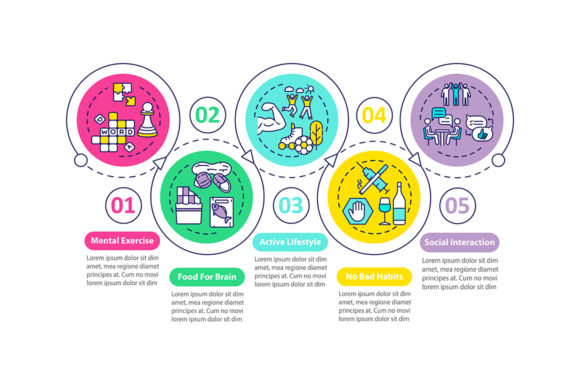
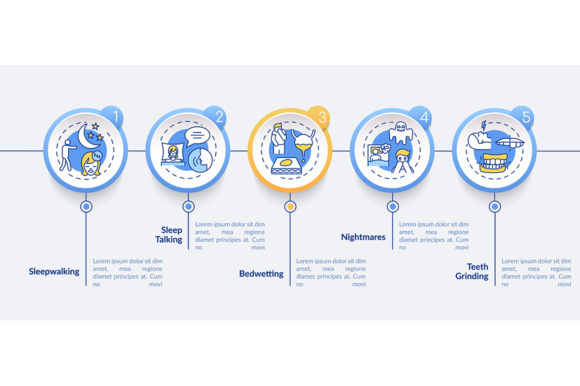
Beyond symptom identification, the template excels at broader data visualization. Health professionals often need to explain the progression of sleep disorders or the steps involved in diagnosis and treatment. The included data visualization with 5 steps provides a ready-made framework for this exact purpose. Whether you are outlining the five stages of sleep architecture or the five-step protocol for cognitive behavioral therapy for insomnia (CBT-I), this modular section allows for quick customization. It removes the guesswork from layout design, ensuring that each step receives equal visual weight and logical flow.
Structuring Information with Timelines and Workflows
Sleep disorders are rarely static; they involve cycles, routines, and temporal patterns. To address this, the template features a process timeline chart that is ideal for illustrating circadian rhythms or the chronic nature of certain conditions. A linear timeline helps viewers understand when symptoms typically occur during the night or how a disorder evolves over months and years. This chronological perspective is vital for distinguishing between acute and chronic issues, a distinction that is often lost in static charts but becomes immediately apparent in a well-designed timeline.
Complementing the timeline is a workflow layout with linear icons designed for modern digital interfaces. Linear iconography offers a clean, minimalist aesthetic that works exceptionally well on screens, reducing visual clutter while maintaining high legibility. This style is perfect for mobile health apps, telemedicine platforms, or responsive websites where space is at a premium. The workflow layout can guide users through self-assessment tools, appointment booking processes, or daily sleep hygiene checklists. By integrating these linear icons, creators maintain a cohesive visual language that feels contemporary and trustworthy.
Practical Applications Across Industries
The versatility of a Sleep Disorder Types Vector Infographic extends far beyond clinical settings. Understanding where and how to apply this resource can maximize its return on investment for various professionals.
- Healthcare Providers: Use the infographic in waiting room displays or post-consultation handouts to reinforce verbal explanations. Visual summaries help patients remember key points about their diagnosis after leaving the office.
- Wellness Bloggers and Influencers: Create shareable social media carousels that explain different sleep types. High-quality vector graphics perform better algorithmically than stock photos and establish the creator as an authoritative source.
- Corporate Wellness Programs: HR departments can utilize the 5-step visualization to present sleep hygiene workshops to employees. Clear, non-clinical visuals make the topic less intimidating and more actionable for staff members experiencing burnout.
- Academic Researchers: Enhance conference posters and journal submissions with standardized diagrams. Using professional templates ensures consistency across presentations and saves valuable time during publication preparation.
- App Developers: Integrate the SVG assets directly into user interfaces for sleep tracking applications. Scalable vectors ensure crisp rendering on all device sizes without increasing app file size significantly.
Technical Specifications and File Formats
One of the most significant advantages of this resource is its comprehensive file packaging. The ZIP file contains EPS, JPG, PNG, SVG, and AI formats, covering virtually every possible use case. Understanding which format to select is crucial for optimal results. Adobe Illustrator (AI) and Encapsulated PostScript (EPS) files are essential for print designers who need to modify colors, resize elements without quality loss, or rearrange components for custom layouts. These source files provide total creative control and are necessary for large-format printing like banners or medical posters.
For digital-first projects, the SVG format is indispensable. Scalable Vector Graphics remain sharp at any resolution, making them perfect for responsive web design and retina displays. They also support CSS styling, allowing developers to animate elements or change colors dynamically based on user interaction. Meanwhile, JPG and PNG files serve as immediate, plug-and-play solutions for users who do not have access to vector editing software. These raster formats are ideal for quick insertion into PowerPoint presentations, Word documents, or email newsletters where advanced editing is not required.
Key Considerations Before Implementation
While the Sleep Disorder Types Vector Infographic template is a powerful tool, successful implementation requires thoughtful consideration. First and foremost is medical accuracy. Design templates provide the structure, but the content must be verified by qualified sources. Always cross-reference symptom lists and statistical data with current medical literature before publishing. A beautiful infographic that contains outdated or incorrect information can damage credibility and potentially mislead vulnerable individuals seeking health guidance.
Accessibility should also be a priority when adapting these designs. Ensure sufficient color contrast between text and background elements, especially when modifying the default color palette. Many people with sleep disorders may view content late at night or while experiencing fatigue, making readability even more critical. Additionally, include alt text descriptions when using PNG or JPG versions online so that screen reader users can access the same information conveyed visually. The linear icons should be paired with text labels rather than relying solely on visual recognition, as icon interpretation can vary across cultures and age groups.
Finally, consider the emotional tone of your adaptation. Sleep disorders can be distressing, and overly clinical or alarming visuals may increase anxiety. The template’s clean aesthetic provides a neutral foundation, but color choices and accompanying copy should aim to be reassuring and solution-oriented. Soft blues, greens, and warm neutrals typically convey calm and restoration, whereas harsh reds or stark blacks might inadvertently signal danger or severity. By balancing informative design with empathetic presentation, creators can produce materials that not only educate but also support the wellbeing of their audience.